Addovation Bank Integration – Prebuilt Integration
Last updated 2026-04-16
_Simple, secure and multi-bank supported integration _
Service Description
Bank integrations are inherently complex because they sit between the ERP system and a banking landscape where security requirements, communication methods, and file formats can vary from bank to bank. Different banks may require different protection mechanisms, such as PGP encryption in one case and a digitally signed secure envelope in another, while the integration layer also needs to manage certificates, authentication, access control, logging, and monitoring in a controlled way. On top of this, financial message handling is not always uniform. Payment files may be created in formats such as pain.001, statement reporting may arrive as camt.053, and some customers still rely on camt.054 or other reporting variants, which means the solution often needs transformation logic, validation, and customer-specific handling instead of simple pass-through connectivity. There is also operational complexity. The integration must securely transmit files, poll for statuses and statements, prevent duplicates, handle retries and failed messages, and maintain traceability so that each file can be followed from the ERP to the bank and back again.
Key Features and Benefits
Automated payment and statement handling
- Feature: Payment files are securely submitted from IFS to Cobase through dedicated API endpoints, while bank statements are automatically retrieved from Cobase, processed by the integration platform, and delivered into the correct IFS environment without manual downloads or uploads.
- Benefit: This reduces manual work in both outbound payment flows and inbound statement handling, while making financial data available in IFS for further processing, reconciliation, and reporting.
Multi-Bank Connectivity via Cobase
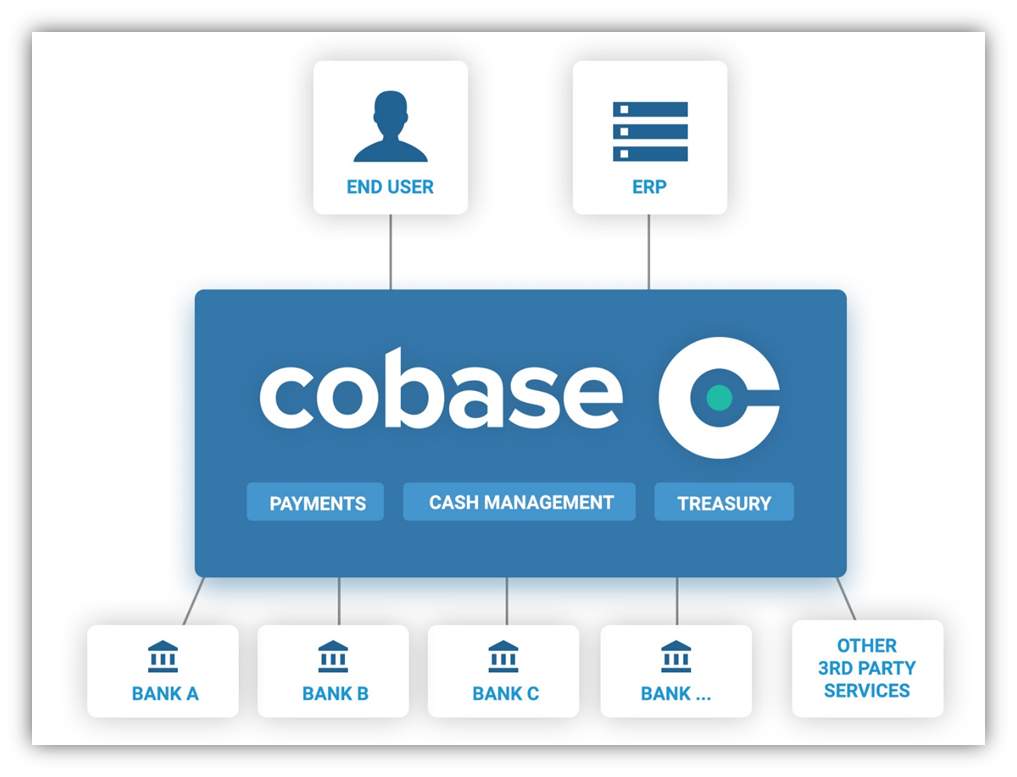
- Feature: Cobase provides a standardized API across multiple banks, allowing organizations to manage multiple banking relationships through a single integration point. As banking setups evolve - with new accounts, banks or regions - the integration remains stable without requiring structural changes.
- Benefit: Manage multiple banking relationships through a single, standardized integration point via Cobase.
Secure payment file processing
- Feature: Payment files are created in IFS and submitted through dedicated API endpoints for secure processing and delivery to Cobase, with support for structured financial formats and multi-currency handling.
- Benefit: This enables standardized, automated payment transmission and reduces manual handling in the payment flow.
Reliability and Observability
- Feature: The platform handles failures through retry and dead-letter mechanisms and provides centralized monitoring through Azure Application Insights, ensuring full traceability and proactive issue detection.
- Benefit: Continuous background processing with retry and dead-letter mechanisms ensures no data is lost. Full observability with centralized monitoring and logging.
Our Offering
Addovation Bank integration delivers seamless and scalable bank integration through its partnership with Cobase, a leading provider of multi-bank connectivity. By acting as a single gateway to multiple banks, Cobase simplifies complexity with a standardized API, support for structured financial formats, multi-currency capabilities, and secure authentication. Addovation’s platform connects IFS with Cobase, creating a streamlined and future-ready integration layer. The result is a fully automated bank data flow that removes manual handling, reduces operational effort, and ensures reliable, continuous processing in the background. Together, this gives customers one secure and efficient integration point for all their banking needs.
Payments
The integration enables secure and fully automated payment processing, helping businesses streamline outbound payments with confidence and control. Payment files are created directly in IFS and sent through the IFS Bank Integration via a secure API, before being forwarded to Cobase for efficient multi-bank handling. This creates a seamless, end-to-end payment flow that removes manual intervention, improves reliability, and ensures standardized communication across all connected banks. With secure transmission, automated processing, and multi-bank support through Cobase, customers gain a scalable and future-ready solution for managing payments efficiently.
Bank Statements
Likewise, the integration also simplifies bank statement handling through a fully automated and reliable statement processing flow. Bank statements are retrieved directly from Cobase and automatically processed by the platform, where transaction files are validated and delivered into the IFS environment. This ensures that financial data is quickly available for reconciliation and reporting, without manual effort or delay. With continuous automated retrieval, dependable delivery into IFS, and full traceability and monitoring throughout the process, the solution gives customers greater visibility, accuracy, and operational efficiency.
Built for Reliability and Fault Tolerance
The integration is designed to provide reliable, traceable, and fault-tolerant handling of both payments and bank statements.
For payments, correlation unique IDs make it possible to trace each transaction throughout the platform, from IFS to the point where the payment is submitted to Cobase. Payments are initiated and managed by the business user in IFS, where it is also possible to see whether a message was successfully sent or if it failed, using IFS Application Messages. If a failure occurs, messages can be resent manually from the same area. After submission, the Cobase GUI is used to monitor payment status. In addition, automatic alerting to support for payment-related issues is currently being implemented.
For bank statements, the handling is asynchronous and message-driven, which helps ensure that no data is lost during processing. Statement files are retrieved from the Cobase application and temporarily stored in a queue before further processing takes place. Each statement file is then processed individually, and built-in retry policies handle temporary failures automatically. If a file still cannot be processed after retries, it is moved to a dedicated error queue for further investigation. Automatic alerting to support for statement-related issues is also being implemented. Successfully processed statement files are archived for 60 days, while any errors that occur after delivery are handled within IFS. As with payments, correlation IDs provide end-to-end traceability, allowing statement transactions to be followed from the point they are received from Cobase until they are delivered to IFS.
Key highlights:
- Competent partner for connecting IFS to Banks
- Bank connectivity hosted and operated by Addovation
- Service desk for any issues or questions
Why use Addovation:
Experience Our long experience working with IFS Cloud will give you ease of mind during onboarding and delivery of the service. We make sure your ERP can send and receive according to the Bank standards.
Flexibility Depending on requirements for other types of functionalities around Banking, Addovation can implement services from other suppliers if necessary.
Ecosystem There are more services available around IFS Cloud as Addovation aims to be a one-stop-shop for the most common services around ERP.
Service Onboarding
Addovation will manage the onboarding to the service which involves the following activities:
- Project management for implementation
- Enablement and configuration of connection between Customer ERP and Addovation Bank integration service
- Testing and verification
Customers responsibility
The following defines any responsibilities for the Customer:
During onboarding
- Any initial Cobase registration during onboarding
- Contact person at Customer for any coordination around bank integration
During delivery of the service
- If any errors occur on a specific bank document, Addovation might need assistance from the Customer to troubleshoot and mitigate the issue
- If changes of the "Bank" standard occurs that involves any development or work in the Customers ERP, this might generate work according to Time & Material. If the ERP is not managed by Addovation, the Customer coordinate with the 3rd party.
Governance and operations
For details, contact Addovation.
Price model
For details, contact Addovation.
Service requirements
For details, contact Addovation.
Release Notes
| Version | Date | Comment or change |
|---|---|---|
| 1.0 | 2026-04-16 | First published version |