Addovation Integration Services
Last updated 2026-05-12
Addovation – your trusted partner for seamless integration
Overview
In today’s digital economy, seamless integration has become the defining factor that determines how well an organization can transform data into value.
Addovation stands at the intersection of enterprise resource planning (ERP) and intelligent connectivity — delivering end-to-end integration services that extend and enhance the value of the IFS and NetSuite ERP ecosystems.
As businesses evolve, their ERP systems are rarely standalone entities. They coexist with a growing ecosystem of SaaS applications, legacy solutions, and industry-specific platforms.
Our mission is to simplify that complexity. By combining deep ERP expertise with modern integration technologies such as Boomi and Microsoft Azure Integration Services, we enable our customers to create connected, resilient, and future-ready digital environments.
Our Foundation: Integration as a Core Competence
Addovation's Integration team is one of its key strengths. With decades of combined experience in system integration, data orchestration, and automation, the team brings proven methodology, technical mastery, and business understanding to every project.
Our specialists are not only experts in integration technology — they also possess an in-depth understanding of IFS and NetSuite business processes. This dual competence ensures that integrations are not just technically correct but strategically aligned with the way the ERP operates and supports the business.
Smart integration
At Addovation, we believe there is a smart way of implementing integrations. Here is a short description about what we mean with smart integrations.
The desired state for most customers is an environment like the one shown in the image:
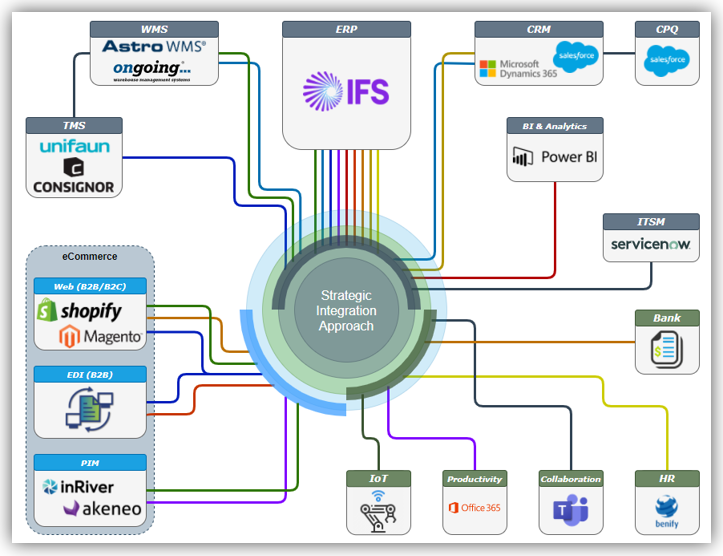
The integrations are built in a unified way from a strategic perspective, facilitating control and a minimum of dependencies.
To get there, smart integrations are required. To achieve smart integrations, two pieces of the puzzle are needed:
- A strategic approach to the integration area meaning an integration strategy needs to be defined.
- An integration platform that supports the strategy.
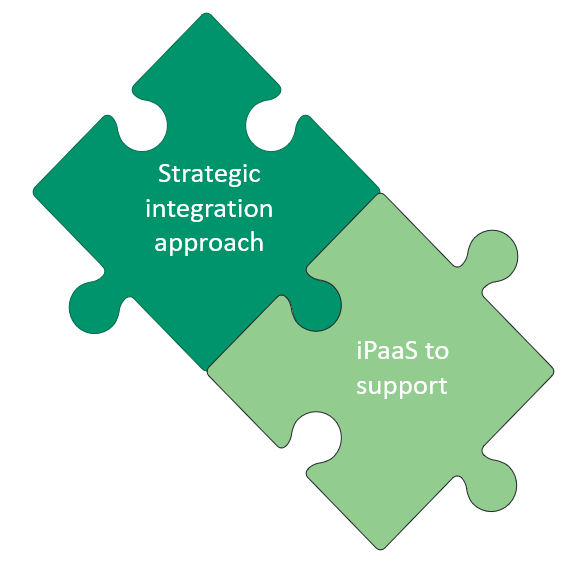
Beyond these puzzle pieces, what do we mean by smart integrations: Smart integration is about business processes being managed seamlessly between different systems and data sources. The aim is to improve the efficiency, scalability and functionality of the business operations.
Here are some characteristics of smart integrations:
- Modern technology is used such as APIs and integration platforms
- High degree of automation and efficiency
- Scalability and flexibility
- Good monitoring capabilities and control
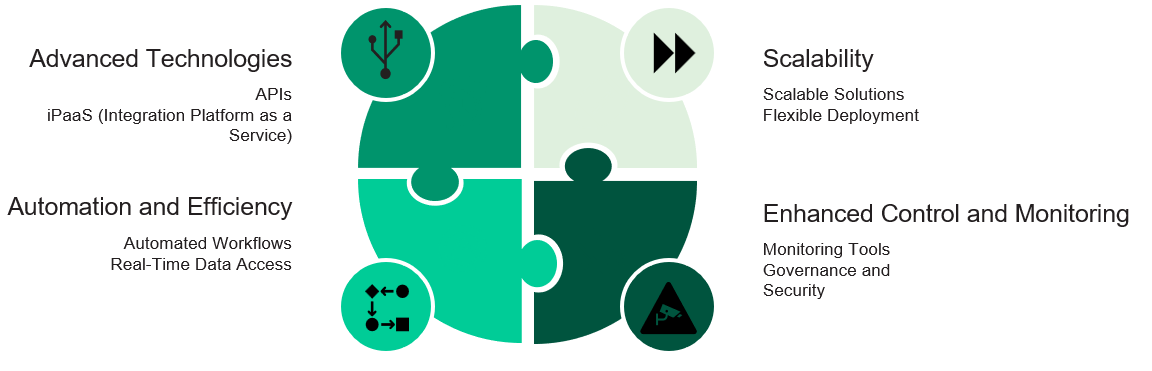
What are the advantages?
- Business processes should be able to be handled across system boundaries without being noticed. The information is accessible in real time “everywhere”.
- It becomes easy to change business processes when, for example, the business grows. No significant changes to the integration architecture are required.
- Integrations become easier to monitor because they are done in a uniform way.
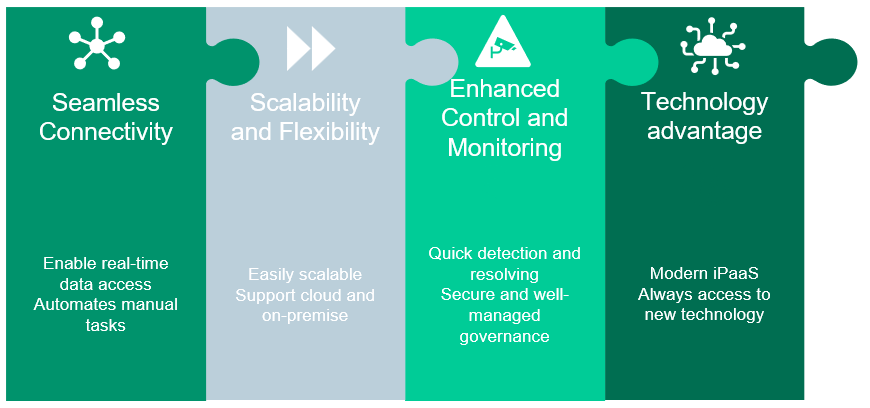
Integration platforms
An organization may need an integration platform for a variety of reasons. One of the main drivers behind the need for integration is the increasing complexity of modern business systems and the proliferation of applications and data sources.
As organizations adopt new technologies and systems, they may find it difficult to effectively integrate these systems with their existing infrastructure.
Another reason an organization may need an integration platform is to enable the integration of legacy systems with newer technologies. This can help to modernize and update older systems, making them more efficient and effective.
Additionally, the increasing reliance on digital systems and data has made it essential for organizations to be able to effectively manage, access, and analyze data from multiple sources. An integration platform can help organizations to bring together data from different systems and make it available for analysis and decision-making.
Overall, the need for integration arises from the need to effectively manage and make use of the growing complexity and diversity of modern business systems and data sources. An integration platform can help organizations to effectively integrate and manage these systems and data, improving efficiency and enabling better decision-making.
The modern integration platforms of today is often called iPaas - Integration Platform as a Service.
Key Features and Benefits
Streamlines integration processes
- Feature: iPaaS provides a central platform for integrating various systems, applications, and data sources
- Benefit: Making it easier to connect different technologies and streamline processes
Improves efficiency
- Feature: By automating the integration of different systems and data sources
- Benefit: Reduces the need for manual data entry and minimize the potential for errors
Enables legacy system modernization
- Feature: iPaaS can help organizations to integrate legacy systems with newer technologies
- Benefit: Modernizing and updating older systems
Increases agility and flexibility
- Feature: iPaaS allows organizations to easily integrate new systems and data sources as needed
- Benefit: Enabling the organizations to respond to changing business needs and adapt to new technologies
Improves security and compliance
- Feature: iPaaS provides a secure platform for data integration
- Benefit: Helping organizations to protect sensitive data and ensure compliance with relevant regulations and standards
Reduces IT overhead
- Feature: iPaas provides a central platform for integration
- Benefit: Helps organizations to reduce the need for dedicated IT resources and minimize the complexity of integration projects
AI enabler
- Feature: (An) iPaaS provides seamless integration of diverse data sources and applications, enabling real-time data flow for AI models
- Benefit: (It) accelerates AI adoption by ensuring high-quality, connected data, which improves model accuracy and business insights
To deliver high-performance, flexible, and cost-efficient integration solutions, we have selected two leading iPaaS technologies: Boomi and Microsoft Azure Integration Services (AIS).
Boomi: Low-Code Agility for Fast-Moving Enterprises
Boomi is a cloud-native integration platform trusted worldwide for its simplicity and speed. Its low-code environment, vast connector library, and enterprise-grade scalability make it ideal for organizations that need to connect diverse systems quickly and reliably.
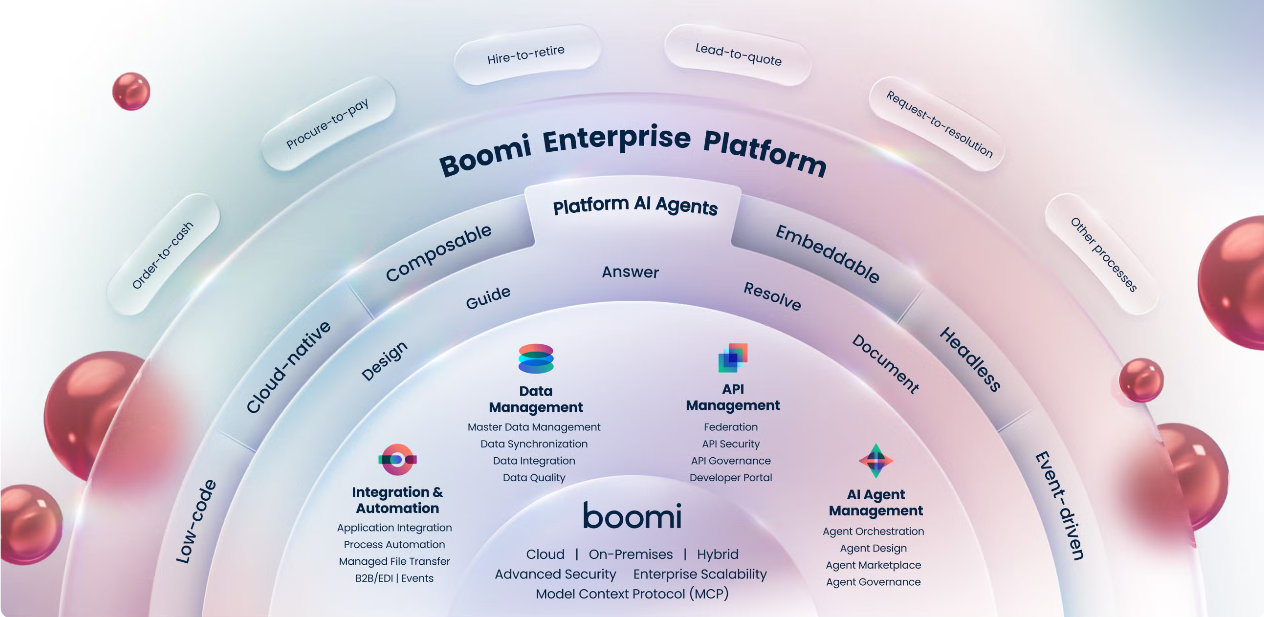
Picture from Boomi website - (Boomi Platform)
Using Boomi, we deliver:
- Rapidly deployed, pre-configured integrations for IFS and NetSuite
- Centralized management and monitoring through Boomi AtomSphere (Replace Boomi AtomSphere with Boomi Enterprise Platform)
- Reusable integration templates for common ERP scenarios (CRM sync, finance automation, supplier portals, etc.)
- Secure data processing with full audit and governance capabilities
Boomi allows our customers to start small and scale easily as their integration landscape grows — all while maintaining full visibility and control.
Microsoft Azure Integration Services: Enterprise-Scale and Cloud-Native Intelligence
For organizations already invested in the Microsoft ecosystem, Azure Integration Services provides a robust, cloud-native alternative. Built around Azure Logic Apps, API Management, Service Bus, and Event Grid, the platform enables complex, event-driven architectures with high performance and security.
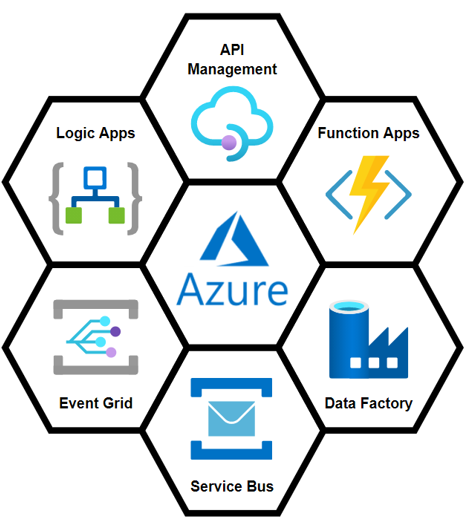
Our team designs and operates Azure-based integration solutions that:
- Connect IFS and NetSuite with a varity of systems
- Support hybrid scenarios, combining on-premises ERP modules with cloud applications
- Enable API-first strategies for business partners and mobile apps
- Provide full lifecycled management, version control, and CI/CD automation through DevOps pipelines
Whether using Boomi or Azure, our goal is the same — to deliver integrations that just work, empowering our customers to focus on their business rather than their middleware.
Our Integration Service Offerings
We offer three distinct but complementary service models, tailored to meet different customer needs and levels of in-house capability.
Integration Partner
As an Integration Partner, we act as a strategic advisor and implementation partner throughout the customer’s digital journey. From architecture design and platform selection to delivery, governance, and support, we ensure a consistent and efficient integration landscape.
Integration as a Service - Addovation Managed Integration
For organizations seeking simplicity and predictability, we offer Integration as a Service — a fully managed hosting and operation model where customers pay a monthly subscription fee that covers everything: licenses, infrastructure, monitoring, upgrades, and support. Our Integration as a Service model provides a fully managed, SLA-backed integration environment delivered as a subscription — removing complexity, reducing risk, and ensuring continuous improvement without the need for internal specialists.
Prebuilt Integrations – Subscription-Based Connectors
For customers who simply want integrations delivered and maintained — without owning the technology or the operational complexity, we offer a growing ecosystem of prebuilt, subscription-based integrations to key partners such as banks, ERP providers, and industry systems. In this subscription-based model, we deliver, host, and support specific integrations, ensuring they remain functional, up-to-date, and optimized over time. These ready-made connectors accelerate time-to-value, reduce implementation costs, and ensure reliable operations.
Together, these offerings position us as a long-term strategic partner for all integration needs — delivering measurable business impact, faster implementations, and a stable, modern integration landscape that evolves with the customer’s business.
Why Choose Us
- ERP Integration Expertise: Decades of IFS and NetSuite experience embedded in every solution.
- Proven Technology: Certified Boomi and Azure Integration specialists using industry-leading platforms.
- Scalability and Flexibility: Solutions designed to grow with your business.
- Service Excellence: Transparent pricing, predictable performance, and proactive support.
- Strategic Partnership: We view integration as an ongoing journey, not a one-off project.
Release Notes
| Version | Date | Comment or change |
|---|---|---|
| 1.0 | 2025-10-16 | First published version |
| 1.1 | 2026-05-12 | Bank Integration added |